
NEWSLETTER – March 2026
From our Chair and the Committee
Our talks coming up:
Message from our Chair, Mellie
At last signs of spring! All my miniature daffodils are blooming in my garden bringing me an immense amount of pleasure, such sweet little things. But also, I have a huge passion for cultivated celandine or Ficaria Verna, formerly known as Ranunculus Ficaria, commonly known as lesser celandine or pilewort. It is mentioned in the below poem by John Clare, one of my favourite poets! How I love the name ‘nose gay’ or ‘tussie mussie’ small fragrant bouquets of flowers or herbs, often wrapped in moss and designed to be held or worn, originating in the 15th Century. Further popularized in the Victorian era, these “nosegays” symbolized sentiments through the language of flowers.
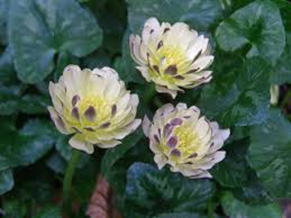
Wild common Celandine grows in abundance in my garden and I have long given up trying to remove them, I just enjoy them for what they are, as best as one can for an invasive and poisonous plant which can be fatal to grazing livestock. Luckily animals seem to instinctively know not to eat it. For all that it does, thankfully it vanishes in summer! However, the cultivated varieties I find intriguing and so pretty. I have several varieties which gently spread. Some have bronze leaves, and some double flowered with the outer side of the petal a beautiful bronze colour. I have a delicate pale primrose coloured one, the outer side of the petals are pale purple. You need to get close to them to enjoy them. So, if you have a wall with a planting hole, or a raised bed or terracing, try and put them at eye level or where you don’t have to bend over too much to look at them. They pop up in early February and slowly start to flower carrying on until the end of May. I have popped in a link to a wonderful grower who has hybridised some stunning varieties. Monksilver Nursery – Joe Sharman – ‘Mr Snowdrop’ Tel no. 01954 251555 – monksilvernursery.co.uk
My first book!
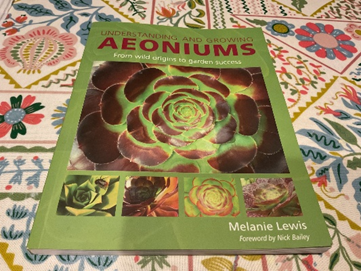
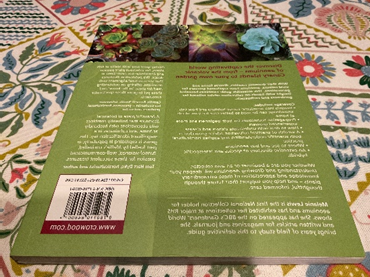
As I mentioned at the February meeting, my very first book about Aeoniums is now published and available. I am very excited. Here are the details:
Understanding and growing Aeoniums – From wild origins to garden success by our very own Melanie Lewis, Foreword by Nick Bailey. You can purchase the book from Crowford Press or from Amazon: Understanding and Growing Aeoniums: From wild origins to garden success eBook : Lewis, Melanie: Amazon.co.uk: Books
Committee
We are still two committee members down so if you can help please get in touch. We are all multitasking on the Committee, some of us are caring for family members with multiple problems, working, or undergoing challenging situations and would appreciate some help with the Garden Club.
Pearl Garden
We are also looking for volunteers to help with the Club’s flower bed, called ‘the Pearl Garden’ located at the front of Lydbury village hall. It was created to celebrate the garden club’s 30th anniversary a few years ago. We will be setting up a rota at the next meeting asking for volunteers to check the garden on a monthly basis and we will arrange some work parties to tidy it up, weed, and add new plants when needed. Mandy has kindly already been and had a tidy up, but further work needed.
Thank you for being a member and hope to see you at the March meeting.
Mellie
February’s talk
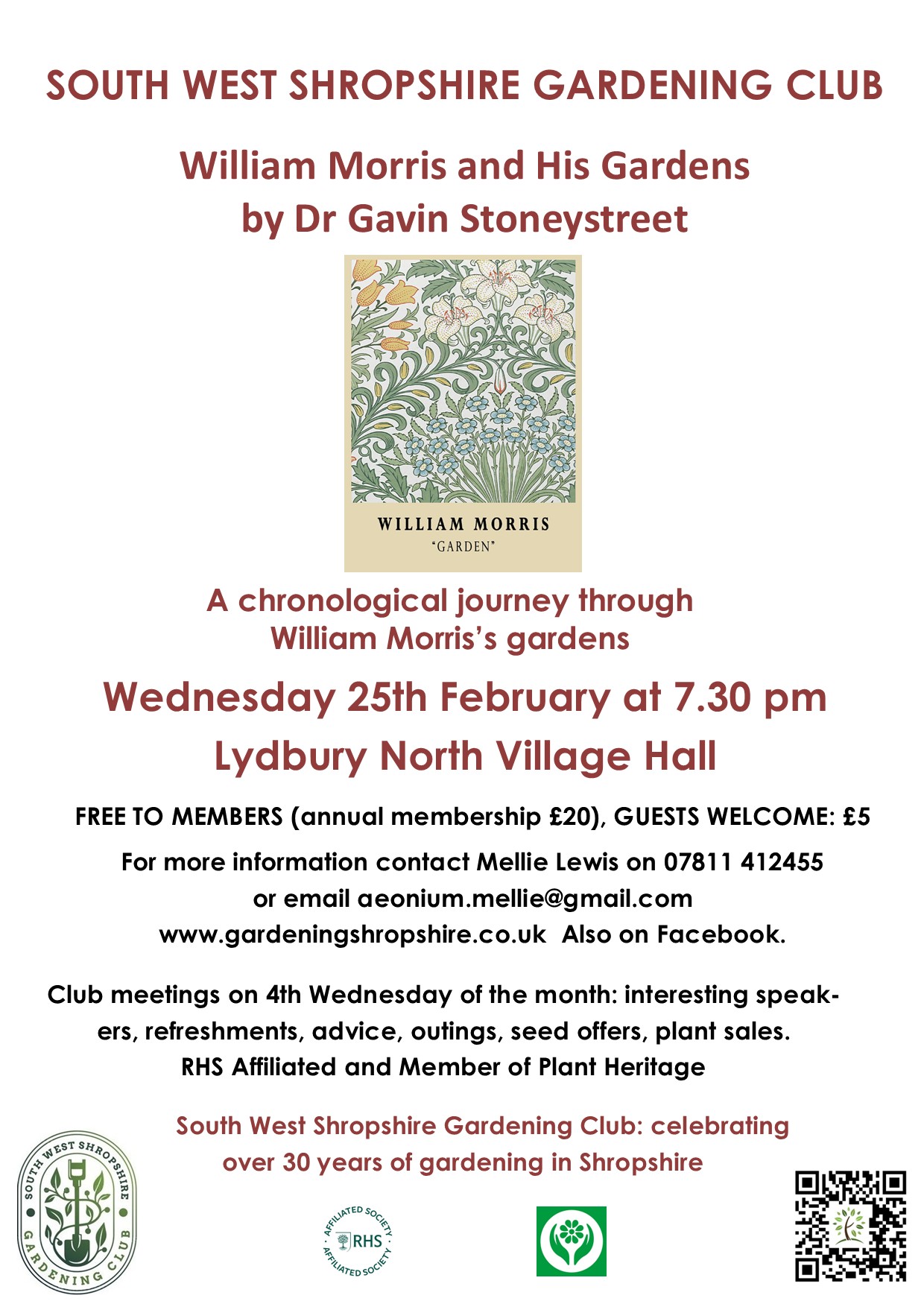
What a great talk by Gavin Stoneystreet during which he shared his passion for all things William Morris. William Morris was a revolutionary force in Victorian Britain: his work as an artist, designer, craftsman, writer and socialist dramatically changed the fashions and ideologies of the era. Gavin told us how the gardens in William’s various houses had influenced the patterns he created, that we love and cherish to this day. It was heart-warming to see how many people came to the talk, especially to welcome quite a few guests who we hope will consider joining the Club. Gavin said about coming to give his talk “You are such a nice and friendly group to visit. And it is great to have an audience fully engaged with the talk.”
Gavin has a book coming out in the Autumn about William Morris and we will make sure that we share the link so you can purchase this if you would like to know more about this amazing pioneer.
March’s talk coming up
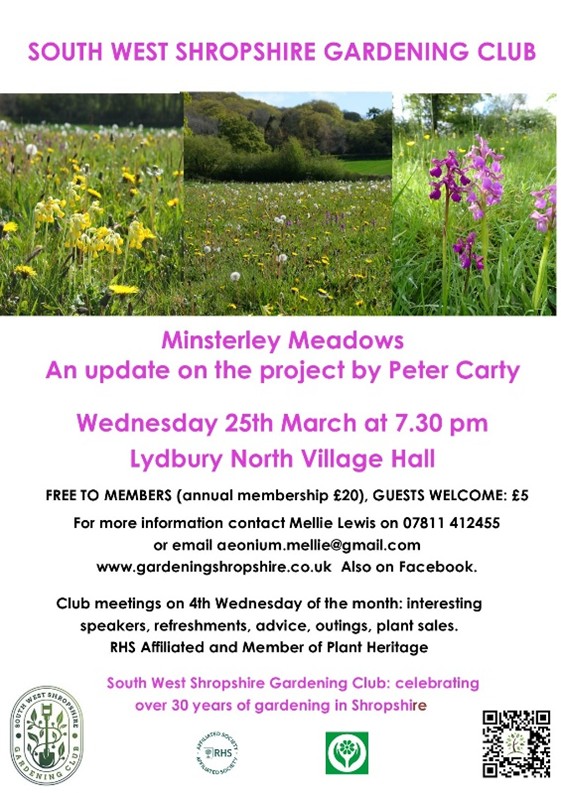
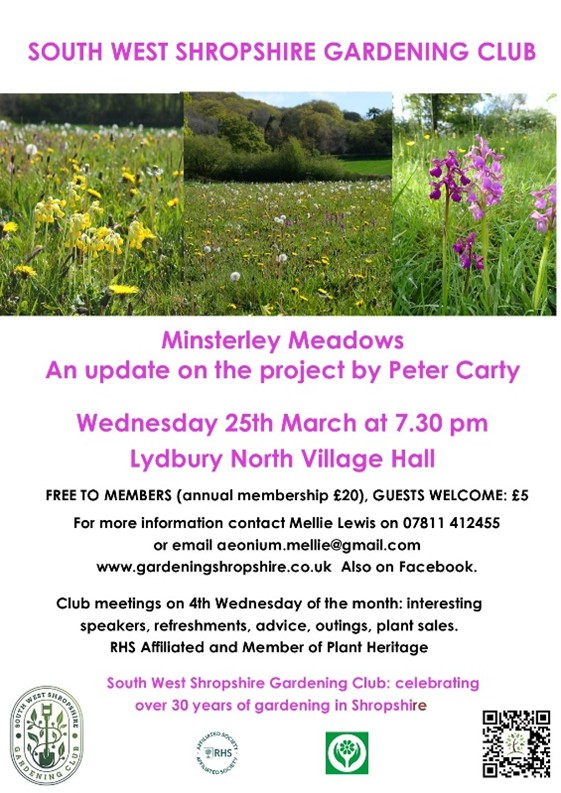
We are really looking forward to hearing about the progress and the onward plans for Minsterley Meadows, the important area that has been purchased to preserve the nature-rich environment which includes the green-winged orchid. You just have to look at the plant species list on the Middle Marches website to see how special this land is. Some of you will remember that the Club supported the purchase of the site through a financial donation and we were very pleased to do so. A small group of members enjoyed a visit to the Meadows last Spring and it was a real pleasure to be there to see the orchids in all their glory.
I am sure Peter’s talk will be very informative about the Meadow and all the other projects that the Middle Marches Community Land Trust are undertaking. I know they have just been successful in their fundraising for the purchase of the White Grit Meadows. You can read more about this here: Middle Marches Community Land Trust | A Trust owned and managed by local people to protect our environment
See our website for the topics and speakers coming up in 2026. If you have any suggestions of speakers you may have heard at other Clubs and you think our members may enjoy the subject, or you have a particular subject you would like to know more about, please let Tina know on swsgcbookings@gmail.com. 2027 is fully booked with an exciting programme to be released later this year.
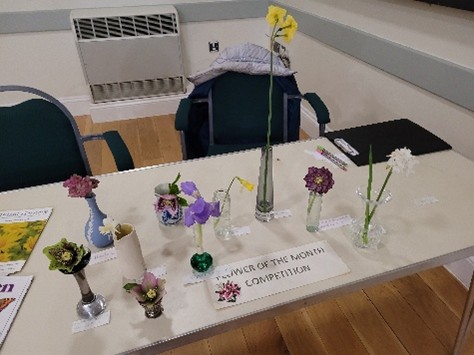
Flower of the Month – February
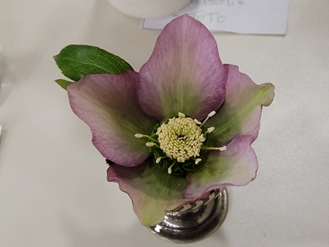
Was won by Rosemary Morris with her beautiful hellebore. Gavin said he was spoilt for choice as all the flowers entered were beautiful.
Member’s favourite plant
Our Club Secretary, Elly, tells us why she loves Mahonia.
Whilst embracing the profusion of colour bought into my garden this month by spring bulbs, forsythia, primroses and celandines amongst others, I don’t want to forget the garden stalwarts that have given me pleasure outside, and also, as cut flowers, inside over winter. Of these my favourite is the Mahonia.
Mahonia is a formerly accepted genus of approximately 70 species of shrubs or, rarely, small trees with evergreen leaves in the family Berberidaceae, native to eastern Asia, the Himalaya, North America, and Central America. They are closely related to the genus Berberis and most botanists prefer to classify Mahonia as a part of Berberis.
Mahonia become large evergreen shrubs with dark-green, spiky leaves, and with one of the varieties I have in my garden, the leaves turn an ‘autumnal’ red in spring. I have two shrubs (inherited with the garden so I don’t know which varieties), one which starts flowering late November/early December and the other not until the New Year. So that one has only just finished flowering. The fragrant bright-yellow flowers that they produce on densely clustered, arching racemes perfume the path along which I pass to the potting shed, greenhouse or compost bin throughout winter. And despite a bit of mess that they make when they shed the small individual flower heads, I bring them into the house with other foliage to put in vases so that I can enjoy their scent in the house.

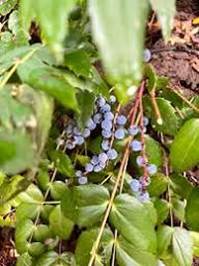
Mahonia is an evergreen shrub with very architectural leaves making it an ideal plant for the back of a border where it will be tolerant of shade. When it gets too tall or too woody it can be hard pruned after flowering when you will notice the yellow colour of the bare wood.
I’ve not tried it myself, but I have read that Mahonia berries (also known as Oregon Grapes) are ideal for making jams, jellies, syrups, and wine, due to their highly acidic, seedy nature. They are described as having a flavour, similar to a tart blackcurrant or a mix of sloe and blueberry. I must give them a try!
Jobs to do in the garden in March
Prune bush and climbing roses
Plant onion and shallot sets
Plant summer-flowering bulbs
Lift and divide overgrown clumps of perennials
Plant early potatoes
Mow the lawn on dry days (if needed)
Cut back herbaceous perennials and ornamental grasses that have been left standing over winter
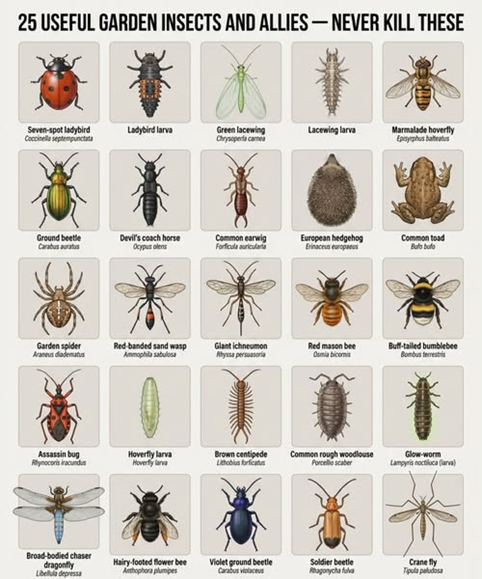
Keep a few dandelions in your garden to support early bees, particularly pantaloon bees – most important for the early pollinators
Start off dahlia tubers in pots or trays of damp peat-free compost
Prune Buddleja to a low framework of stems to encourage new flowering growth
- Items for sale or for free
One small wormery looking for a home for life. Please email Mandy – bonnilass@hotmail.com if you want to know more about it. - Free plants
Fifteen or so pink/purple established aubretia for free. Please contact Lesley Baddeley on 01588 630446 if you would like to give a home to one or more of the plants. They are currently in her garden in Bishop’s Castle.
RHS Affiliation
Don’t forget that our Club is affiliated to the RHS so you can borrow a discount card which offers 50% off entry for two people, to any RHS Garden (Bridgewater, Harlow Carr, Hyde Hall, Rosemoor and Wisley). It is not accepted for visits during Flower Shows and Glow Illumination events.
Every month, we receive, as a Club, a copy of the RHS Garden magazine. This is brought to the meetings, and you are most welcome to borrow this to read and return at the next meeting. They are usually on the table for the Flower of the Month or at least close to that table.
Membership
Membership costs £20 to cover attendance at all our meetings for a year (from October). For those joining partway through the year, the membership fee will be slightly discounted; early access to trips and events with subsidised tickets; seed offers and plant sales. We are affiliated to the RHS so you can borrow our discount card which provides 50% discount for two people to any RHS garden. Such a bargain! Payment can be made with cash, cheque, or card at our meetings or by transfer to: South-West Shropshire Gardening Club sort code 20-53-22 account number 80754803. Please add your name as reference and email our Treasurer, Tina, to let her know: swsgcbookings@gmail.com
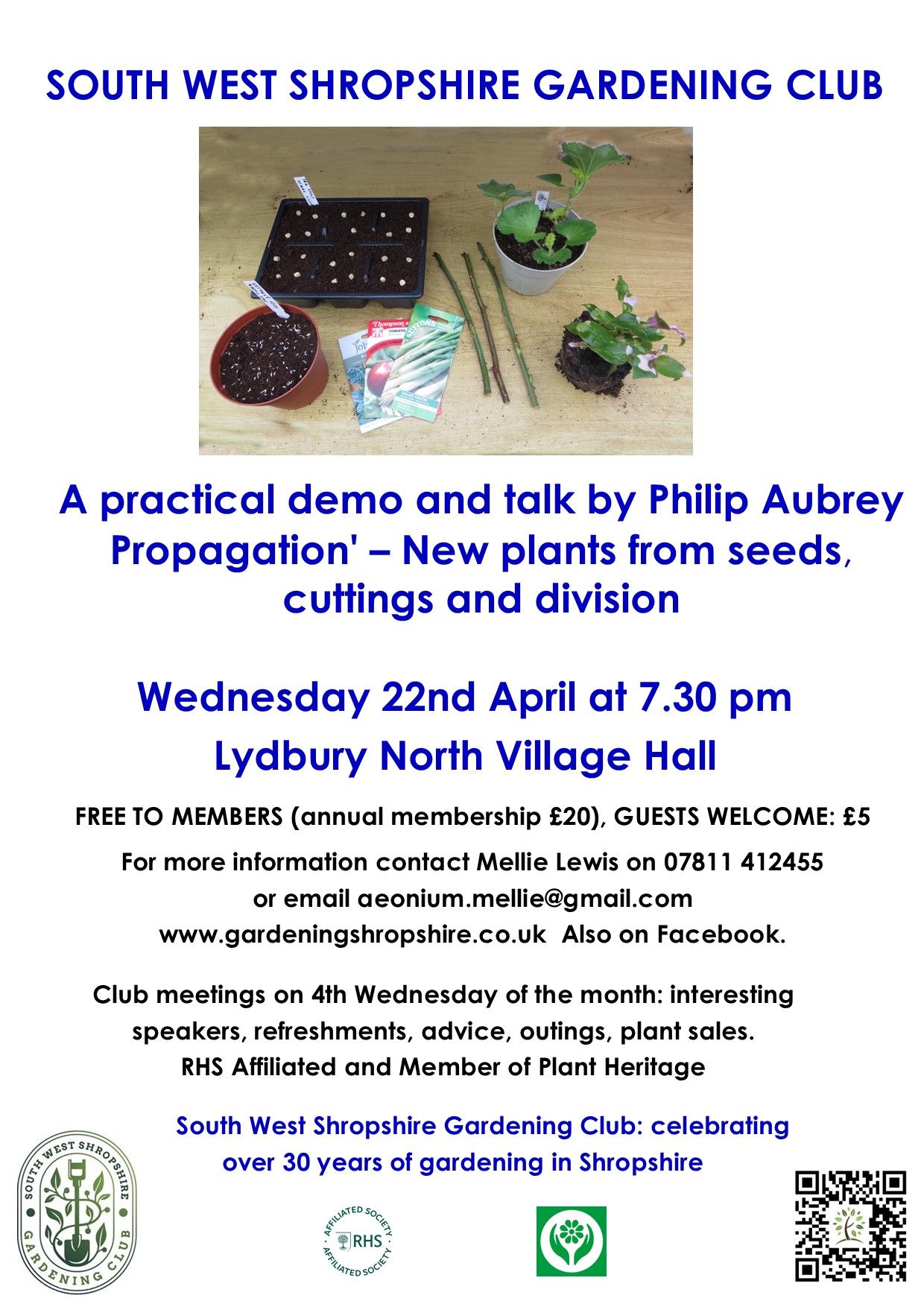
Easter Planter workshop £25 on Friday, 27th March, 2 pm – 4.30 pm at Lydbury North Village Hall.
Led by Georgina Painter-Black, from Georgina’s Flowers. Georgina designs fresh and dried floral arrangements using material from her country garden near Tenbury Wells. For our workshop she will provide basket making materials, spring bulbs, succulents and foliage and guide us to create a beautiful, natural planting arrangement for Easter/spring that we can use indoors or out. All materials and refreshments will be provided. To reserve a place please contact Elly Bibby 0780 2497780 / ellisonbibby05@gmail.com We have a few places left.
Tea Rota at meetings
Thank you to all those who have signed up or actually done a stint serving teas. Much appreciated. Would be great to fill up the chart for the coming year. See the chart on the desk as you come in to the Hall on the evening of the talks to fill in. If lots of people take a turn, it means you only need to help every now and then.
Chelsea Flower Show – weekend holiday package
We have been contacted by a travel consultant, Laura Clare, who works for Flamingo Holidays, part of Hays Travel (ABTA No P7133). She is a homeworker for this company and has sent us details about a two-night package that she thought our members may be interested in. The details are as follows:
“The package includes two nights at the elegant four-star Gem Strathmore Hotel in South Kensington (22nd–24th May 2026), full English breakfast each morning, a glass of Prosecco on arrival, two tickets to RHS Chelsea Flower Show on Saturday 23rd May, and two one-way river cruise tickets — all from £449 per person (based on two people sharing).
Many gardening enthusiasts look forward to Chelsea each year, and this break allows them to enjoy the show at a relaxed pace while turning it into a memorable London getaway — with the reassurance of full ABTA protection.”
If this is something you might be interested in, please contact Laura on her email which is lauraflamingoholidays@gmail.com and she would be delighted to send further details, discuss a potential group booking, or answer any questions.
Please note: The Club holds no responsibility for bookings made through this company and is receiving no commission for any bookings made. We are just acting as a noticeboard.
Plant Heritage
We also belong to Plant Heritage and have two cards which enable members to attend local meetings and events. Please contact Mellie if you would like to use the cards.
The Club’s Social Media
Do not forget that we have an active website and Facebook page, which are regularly updated. You can post on the FB page, and this will be loaded up once the Administrator has approved it. It is a great way of sharing news about all things gardening.
A bit of health and safety
As we are now well into the season for coughs and sneezes, please, if you feel unwell, reconsider whether you should be coming to an indoor event. Covid still is around as is flu and we do have several vulnerable people who do attend the meetings.
Events coming up and places to visit in our local area and beyond
Wildegoose Nursery, The Walled Garden, Craven Arms, SY7 9HE will open again on 26th March which is not far away now. They are not open every day so please check their website: Wildegoose Nursery – Shropshire
Kings Nursery, Garthmyl, Montgomery, SY15 6RT has opened on 2nd March for perennials, violas, and pansies. The greenhouses for annuals etc will be open on 28th March. Remember there is the wonderful Green Café there also which also now has a bakery as well. Greenhouse Cafe and Kitchen | Cafe in Welshpool | Garthmyl, Montgomery SY15 6RT, UK
NGS Gardens are opening! Two in Shropshire open over the Easter weekend and you can find out more details on the NGS website: www.ngs.org.uk
Upper Farm Gardens, Rushton, Shrewsbury. TF6 5AG. A farmhouse garden with views of the Wrekin and the Stretton Hills.
Cherry Tree Arboretum, Cherry Tree Lane, Woore, CW3 9SR. 50 acres of unspoilt pastureland scattered with mature oaks and the earliest blossoming cherries.
Ashwood Nursery Plant Fair – Saturday 25th April 10am – 4pm – A brand new plant fair for 2026, which is surely set to be a very special one. Held in John Massey’s private garden, it is set to be a fabulous day, with nurseries such as Crug Farm Plants, Aberconwy Nursery, Gwaun Valley, Hardys, Wildegoose and Pottertons in attendance.
The Newt Plant Fair – Saturday 16th May – As part of ‘the Great Garden Show at the Newt in Somerset’ the gardens will be playing host to a specialist plant fair. More details to follow soon, however for now save the date.
Other plant fairs this Spring:
Arley Hall Plant Hunters Fair – Sunday 22nd March 10am to 4pm
Great Dixter Spring Plant Fair – Saturday 11th and Sunday 12th April 11am to 4pm
Cholmondeley Castle Plant Hunters Fair – Sunday 26th April 10am to 5pm
The Cart Shed Spring Plant Fair at Garnons – Wednesday 29th April
Miscellaneous!
Something to give your system a boost as we come out of winter and use some of those nettles that are in our gardens and the countryside. A regular in Mandy’s house at this time of year to boost the immune system. They are full of Vitamin A and C, 2.3% by weight of iron and a remarkable 5.5% of protein.
Nettle Soup (not to be made after June as the nettles are too tough)
Several large handfuls of nettle tops (use gloves when picking the nettles!)
1 large onion
50 gms butter
2 potatoes chopped into cubes
1 litre of vegetable stock
1 tablespoon of crème-fraiche
Seasoning including grated nutmeg
- Strip the nettles from the thicker stalks and wash well
- Melt the butter and simmer the chopped onion in it until golden.
- Add the nettles and the chopped potatoes and cook for 2-3 minutes
Add the stock and simmer for 20 minutes, using a wooden spoon from time to time to crush the potatoes
- Add the seasoning, plus a little grated nutmeg and serve with a swirl of crème-fraiche.
- If you prefer a smoother soup, put the mixture through a liquidiser before serving. Reheat and add seasoning and crème-fraiche.
NEWSLETTER – February 2026
From our Chair and the Committee
Our talks coming up:
Message from our Chair
‘One month is past, another is begun,
Since merry bells rang out the dying year,
And buds of rarest green began to peer,
As if impatient for a warmer sun;
And though the distant hills are bleak and dun,
The virgin snowdrop, like a lambent fire,
Pierces the cold earth with its green-streaked spire
And in dark woods, the wandering little one
May find a primrose.
H. Coleridge
This month, I find perhaps a little more difficult than others, Yule is a distant yet lovely memory, and although February is the shortest of the months, when the weather is continuously wet and cold I find myself longing to be in the garden on warm spring day, tidying up the dead and fallen remains of previous summer, looking to see what has popped up new and what jobs to put on my list. Thank goodness for a few precious darlings such as the Snowdrop, the Fair Maids of February!
We are all aware that rare and unusual snowdrops can command high prices, and there are literally thousands of varieties commanding sometimes thousands of pounds for one bulb such is the intrigue and fascination for this little fair maiden. Even walking around Clun I have counted half a dozen different types just growing wild in hedgerows and on the Memorial Hall and Castle grounds. But did you know that apart from splitting snowdrops ‘in the green’ once flowering has finished or removing bulb offsets and potting them on, there is another way to propagate your rarer Snowdrops. There is a really good article in Gardens Illustrated about the work of Margaret MacLennnan, a wonderful ‘green fingered’ lady! Well worth the read, here is the link https://www.gardensillustrated.com/gardens/white-magic-how-to-propagate-snowdrops But if you cannot get the link or the magazine here below is a quick guide.
Step 1: After removing the top quarter of the bulb (cutting parallel to the root-plate), make the first longitudinal cut to divide the bulb into two equal pieces.
Step 2: Bulbs can be divided into four, eight, 16 or 32 equal pieces (‘chips’) of bulb, ensuring each has a portion of the root-plate attached. Margaret seldom divides a bulb into more than eight chips as smaller divisions take longer to reach flowering size.
Step 3: For twin scaling, further longitudinal incisions may be made to divide the chips into separate bulb ‘leaves’ or ‘scales’, with the blade perpendicular to the axis of the ‘chip’ of bulb.
Step 4: Soak the propagules in a fungicide solution for 20 minutes and place in a sealable container on a bed of vermiculite. Add a covering layer of vermiculite then seal the box and keep it somewhere dark at 21°C. Check every few days for rot, but after 12-14 weeks they should be ready to pot up.
Also check out Dryad nursery https://www.dryad-home.co.uk/ Another Green fingered Goddess of gardening, snowdrop lady and home of miniature daffodils!
In Northern Island check out https://www.ballyrobertgardens.com/products/galanthus-hill-poe-d?srsltid=AfmBOopuU3lQDy3bSS9ChfKC9WSQ02ioCXQyG6pT2zWPDC62cm_Eub5W
I have habitually used these nurseries and always found them exceedingly good.
January’s talk
No-one who attended Adam Kirtland’s talk on 28th January about a Bulb for Every Day of the Year (a last minute change of subject) has any excuse not to have a bulb flowering every month. Highly informative and full of ideas about what to plant to give your garden reliable flowers all through the year with little maintenance. You can find Adam on Facebook and Instagram where he posts regularly with ideas and tips – look for Adam Kirtland – A View from the Bench.
February talk coming up
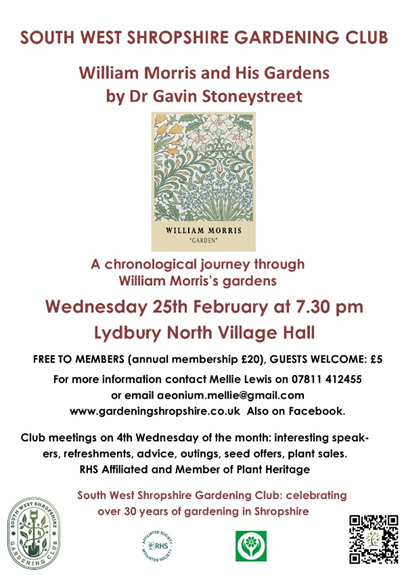
Dr Gavin Stoneystreet, who has been to talk to us before, will come and give us a talk looking in chronological order, at the gardens of William Morris. Gavin will be looking at the influence they had on his pattern designs and on the wider world of garden design. Including Red House created with the help of his friends in the Pre-Raphaelite brotherhood, Kelmscott Manor, and the garden at his dye works factory at Merton Abbey, an environmental oasis in the centre of industrial London.
See our website for the topics and speakers coming up in 2026.
Flower of the Month – January
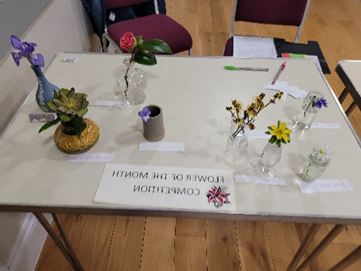
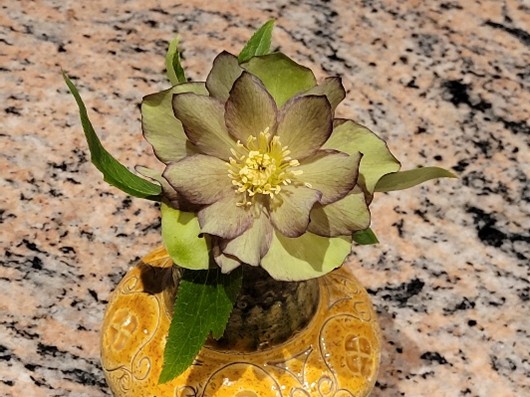
This month’s winner was Helen Brown with her beautiful Hellebore Orientalis. Well done Helen.The quality and choice of flowers for Adam to choose from was incredible.
Member’s favourite plant
A favourite flower by Sara Roberts, our Membership Secretary
Despite some rare treasures in the garden and the opportunity to wear woolly jumpers and huddle by an open fire, I really do not like the winter. However, as we have drifted through January into February, I have been wowed by the masses of snowdrops lighting up my garden and the countryside. I have admired the crocuses that are now bravely pushing up flower buds in yellow and purple, and I’m anticipating the arrival of one of my favourite early spring flowers – the primrose.
The common primrose, Primula vulgaris, is the most well-known of the 4-5,000 species within the Primula genus. Where I lived in Cornwall, they were abundant in the way that snowdrops are here in the Clun valley. My garden lawns, the roadside verges and the banks of the castle moat were all studded in primroses, pretty in pale yellow, with the occasional pink.
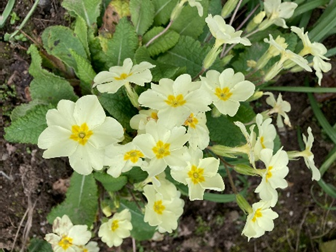
‘Thrum’ primroses in my garden
They are an impressive sight en masse, but observed close up the flowers are fascinating. Each plant only has flowers of one form, either ‘pin’ (female part uppermost) or ‘thrum’ (male parts uppermost). This clever design reduces the chance of self-fertilisation and encourages genetic variation.

Cowslips running wild in my parents’ garden
Closely related to the primrose is the cowslip, Primula verni. It has a cluster of smaller flowers on an upright stem. It will grow in abundance in a grassy meadow, but many of these habitats have been lost. It thrives in my parents’ clay soil garden in North Derbyshire but, despite my efforts, failed to thrive in my coastal garden. I’ve yet to try transplanting it into my garden in Clun, but I’ll add that to my gardening job list.
Primroses have been popular garden flowers since Elizabethan times, and they have been extensively cultivated and hybridised. The term Polyanthus refers to various tall-stemmed and multicoloured hybrid crosses of the primrose and the cowslip. They feature clusters of primrose-like flowers on sturdy upright stems and are often used to bring splashes of vibrant colour to containers and borders. They have their place, but I prefer the subtle and delicate beauty of the common primrose over these showier specimens.
I am, however, attracted to some other Primula species. On our trip to Cholmondeley Castle gardens last June, we saw drifts of pinky-orangey-yellow candelabra primroses lining the edge of the lake. When I replant around my own (rather smaller!) garden pond, these will be a must.
And what about the alpine and border auriculas and laced primulas made popular by the Victorians? They have a precise beauty that has been a fascination for breeders and collectors. To me they have a sense of mystery. I own a couple of auricula plants that have been sulking in their pots for the last five years. The common primrose seems to thrive on neglect, but these related plants may be a little fussier! Can anyone in the Club advise me how to care for these little treasures?
If you would like to tell us about your favourite plant, do send a small paragraph and a photo to Mandy on bonnilass@hotmail.com
Jobs to do in the garden in February
February is a crucial month for gardening, with various tasks to prepare your garden for the upcoming growing season. Use this time to plan your garden layout, decide what to plant, and order seeds. Having a clear plan helps ensure a successful growing season.
Start seeds indoors for early vegetables and flowers. This is especially important for plants that need a head start before being transplanted outside.
Prune trees, shrubs and perennials as needed. This includes cutting back ornamental grasses and trimming climbing plants like wisteria and clematis to encourage growth.
Check and prepare your soil for planting. This may involve adding compost or other organic matter to improve soil health
February is a good time to plant certain flowers bulbs such as lilies and alliums directly into the ground.
Potatoes can start to be chitted indoors to extend the growing season and this can lead to a lager harvest when planted outdoors.
Clean your greenhouse or polytunnel to maximise light and reduce pests. Also, clear pathways of moss and algae to maintain a safe and tidy garden.
Brighten up your space by planting colourful spring plants in containers. This can add life to your garden during the still cold days of February.
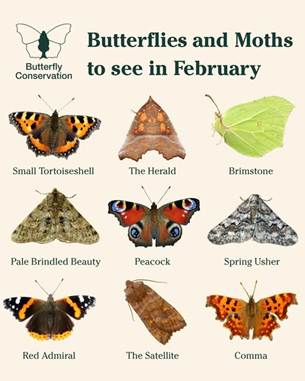
What to look out for in our gardens and the countryside in February
Items for sale or for free
We still have one donated wormery that needs a new home. Please email Mandy – bonnilass@hotmail.com if you want to know more about it.
RHS Affiliation
Don’t forget that our club is affiliated to the RHS so I can lend you a discount card which offers 50% off entry for two people, to any RHS Garden (Bridgewater, Harlow Carr, Hyde Hall, Rosemoor and Wisley). It is not accepted for visits during Flower Shows and Glow Illumination events.
Every month, we receive, as a Club, a copy of the RHS Garden magazine. This is brought to the meetings, and you are most welcome to borrow this to read and return at the next meeting. They are usually on the table for the Flower of the Month or at least close to that table.
Membership
OVERDUE! Membership costs £20 to cover attendance at all our meetings for a year (from October); early access to trips and events with subsidised tickets; seed offers and plant sales. We are affiliated to the RHS so you can borrow our discount card which provides 50% discount for two people to any RHS garden. Such a bargain! Payment can be made with cash, cheque, or card at our meetings or by transfer to: South-West Shropshire Gardening Club sort code 20-53-22 account number 80754803. Please add your name as reference and email our Treasurer, Tina, to let her know: swsgcbookings@gmail.com
Tea Rota at meetings
Just a reminder, do sign up to help with the teas and you can find the tea rota on the desk as you arrive in the Hall. If lots of people take a turn, it means you only need to help every now and then. You can find the rota on the desk as you come into the Hall at the next meeting.
Plant Heritage
We also belong to Plant Heritage and have two cards which enable members to attend local meetings and events. Please contact Mellie if you would like to use the cards.
The Club’s Social Media
Do not forget that we have an active website and Facebook page, which are regularly updated. You can post on the FB page, and this will be loaded up once the Administrator has approved it. It is a great way of sharing news about all things gardening.
A bit of health and safety
As we are now well into the season for coughs and sneezes, please, if you feel unwell, reconsider whether you should be coming to an indoor event. Covid still is around as is flu and we do have several vulnerable people who do attend the meetings.
Events coming up and places to visit in our local area and beyond
Do check out the Hardy Plant Society’s website for Shropshire which has the listing of talks and visits to attend. See this link: Shropshire – Hardy Plant Society
Wildegoose Nursery, The Walled Garden, Craven Arms, SY7 9HE will open again on 26th March which is not far away now. They are not open every day so please check their website: Wildegoose Nursery – Shropshire
Kings Nursery, Garthmyl, Montgomery, SY15 6RT opens on 2nd March for perennials, violas, and pansies. Remember there is the wonderful Green Café there also which also now has a bakery as well. Greenhouse Cafe and Kitchen | Cafe in Welshpool | Garthmyl, Montgomery SY15 6RT, UK
Miscellaneous!
Completely nothing to do with gardening, in these cold wet days Mellie wanted to share her favourite soda bread recipe with you all………….
Irish soda bread has always been a comfort food for me especially in winter months, filling, delicious and easy to make, keeps well too and isn’t expensive to make. Goes well with a big bowl of steaming hot soup on a cold miserable day especially when fresh out of the oven! It seems to be ‘out of fashion’ a forgotten loaf of yesteryear so I thought I would share the recipe! It is also a good one to make if you have children in your company with the bicarbonate reaction!

| Ingredients: 170g/6oz wholemeal flour 170g/6oz plain flour, plus extra for dusting ½ tsp salt ½ tsp bicarbonate of soda 290ml/10fl oz buttermilk. (I used oat milk for a vegan alternative. ) | |
Method
- Preheat the oven to 200C/180C Fan/Gas 6
- Tip the flours, salt, and bicarbonate of soda into a large bowl and stir. Make a well in the centre and pour in the buttermilk, mixing quickly with a large fork to form a soft dough. (Depending upon the absorbency of the flour, you may need to add a little milk if the dough seems too stiff, but it should not be too wet or sticky)
- Turn onto a lightly floured surface and knead briefly. Form into a round and flatten the dough slightly before placing on a lightly floured baking sheet.
- Cut a cross on the top and bake for about 30 minutes or until the loaf sounds hollow when tapped. Cool on a wire rack
If you have an unusual recipe, especially if it is from garden produce, please send it to Mandy at bonnilass@hotmail.com. Local produce recipes, recipes belonging to Shropshire, war-time recipes and hacks, or recipes passed down from generations possibly with a story attached would be great.
NEWSLETTER – January 2026
From our Chair and the Committee
Our talks coming up:

New Year Message from Mellie, our Chair
Happy New Year!
December and the festivities are behind us, and the light is slowly returning, and yet we are still in winter’s grip!
At this time of the year, many people feel very down or even depressed. Three of my family members suffer from SAD syndrome (Seasonal Affective Disorder) and dread the onset of Autumn. Thankfully I’m quite the opposite and love our changing seasons. For me Climate Collapse is what I fear most. The exceptionally wet weather that causes flooding and the scorching heatwaves that seem to be blighting us, I find deeply disturbing, perhaps a topic of discussion for another time. What brings me calm, a sense of being and a feeling of peace, is an early morning walk as dawn begins to break and the Robin starts to sing, when I find myself studying the silhouetted tree shapes. I love how the stars shine through the twigs even as the light begins to shine. The Robin’s song is soon joined by others, Song Thrush, Redwing, Wren, the calling of the Corvid family and the cooing of Collared Doves and Wood Pigeons.
Best of all is a cold dry morning with a red sunrise, the glow hits the twiggy hedgerows and trees, and suddenly it’s like the world is on fire! Dog woods always look terrific at this time of year with their blazing twigs. In the garden, the burgeoning of bulbs is evident and the Hellebores nodding heads in an array of colours, capture my attention. Who can resist the beauty of a Snowdrop especially if a bee is foraging for nectar. Aconites are another favourite of mine, their happy yellow faces defying the bleakest of weather to shine a bit of sunshine on the garden border.
I also love Daphnes I cannot believe that such a plant can bloom at this time and deliver such fragrance, I grow my Daphnes near the back door so that they can be admired and sniffed even in the most fowl of weather. My most favoured Daphne is Transatlantica Eternal Fragrance which blooms all year round and the perfume is delicious, it is hardy and forms a lovely mound. I also really like Daphne Bholua Jacqueline postille AGM with its clusters of small sweetly fragranced pink flowers that open in January and February, followed by purple/ black berries. Oh, and then there is Daphne Mezereum Rubra with its gorgeous pink flowers. During the colder months the magnificent blossoms sprout straight from the bare stem the scent fills the air.
Indoors, I love to have Hyacinths which are easy to grow but it is the perfume that does it for me as they remind me of my childhood as my father has always loved a few Hyacinths. A vase a supermarket Daffodils can be an uplifting treat especially if they have come from Cornwall or the Channel Islands. And finally, feeding the birds is my favourite waste of time on a miserable day when you feel stuck indoors by bad weather, I can happily kill a couple of hours watching my feathered friends feast on the seeds, kitchen waste, apples that fell in autumn and the berries. I recently watched a Blackbird swallowing fruits of the crab apple, I watched in amazement as it made light work of the seemingly too large for its size fruits swallowed whole! A good source of food for many birds, bees butterflies and invertebrates, Crab apples have to be a top garden tree, with beautiful blossoms in Spring, followed by fruits of all colours shapes and sizes, or you can make good old fashioned Crab Apple Jelly!
This year we will be looking at sustainability, and please don’t be shy if you have any tips you can share with us !
Soon the Committee will meet to discuss our plans for this year, which will include how we proceed not having anyone in charge of ‘publicity’ or ‘speaker bookings’. Please if you can help us, we would love to hear from you. The publicity officer does not necessarily need to be on the Committee, it is more of a case of making sure posters are printed and distributed, contacting media with updates of our speakers, meetings and events…and a few other smaller tasks like updating Facebook. Not having these two officers is putting a strain on our Committee who are working hard to make sure our Club keeps a high-profile and is valued by its members. We are all having to multi-task.
We will be looking at suitable places for our summer outing and starting with the organisation of that.
We hope you will enjoy bringing in unwanted or surplus plants, seeds or garden related items for the ‘swap table’. Please bear in mind if your item/s is not taken you must take home at the end of evening.
Please remember January is also an EGM which shouldn’t take long or be too onerous. The new constitution is available on website, and this just needs voting in plus two other officers missed in our AGM.
I look forward to seeing you at our meetings and events over the year.
Mellie
December’s talk and Christmas festivities
What a fascinating talk in December given by Steve Knight about the lives of bees and how we can best encourage them into our gardens. Absolutely packed with information and Steve has shared his three slides about what plants we should be having in our gardens to encourage pollinators, which are available on our website. Also, some brilliant bee products were available on the night to purchase.
Christmas Robin Redbreast Arrangement Winner
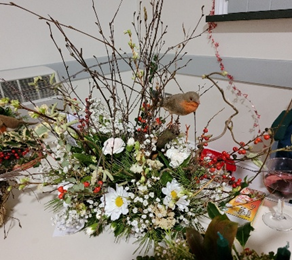
Mellie Lewis won the Christmas competition with her beautiful arrangement and Helen Brown and Debbie were joint second. Well done to them all. There were many beautiful arrangements for Steve to choose from so thank you to all who participated. See Mellie’s arrangement below.
Tea Rota at meetings
Just a reminder, do sign up to help with the teas and you can find the tea rota on the desk as you arrive in the Hall. If lots of people take a turn, it means you only need to help every now and then. You can find the rota on the desk as you come into the Hall at the next meeting.
January talk
Sadly, we had to postpone Adam Kirtland’s talk – Garden DIY using just a wooden Pallet -last year at the last minute but we are delighted that he is now coming to give us his much-anticipated talk on 28th January at 7.30 pm.
Adam Kirtland, otherwise known online as View from the Potting Bench, is a gardener, professional writer (Amateur Gardening Magazine, Garden News and Garden Answers) and podcaster with a passion for budget gardening, but on a big scale. Budget doesn’t always mean boring! In this talk he’ll be showing you just what you can make yourself and exactly how you can do it
See our website for the topics and speakers coming up in 2026.
Jobs to do in January
Now is a great time to prune soft fruit buses such as currants and gooseberries – especially new bushes or cordons. It is also the season to winter prune apples and pears and plant bare-root trees and bushes as long as the soil isn’t frozen.
You can sow broad beans in pots in mild areas placing them in a cold frame or unheated greenhouse. Crops to sow indoors include lettuce, summer brassicas, spinach, salad onions and turnips. You can also sow onion seed in a heated propagator. And don’t forget the sweet peas. By planting them this early, will guarantee some early blooms.
Year of Sustainability
During 2026 the Committee have decided that this will be our Year of Sustainability which covers a multitude of subjects – growing our own, gardening without chemicals, recycling and resusing,growing the right plants for pollinators, the list goes on. Some of our talks coming up this year (a flower farmer from Ledbury, growing your own and making produce from your produce – do reflect sustainability and we will be coming up with all sorts of ideas throughout the year to promote a kinder to the planet and all who live on it way of working in our gardens, allotments and in our lives generally. We would welcome any ideas that any of you have to promote this to the Club.
We hope that you enjoyed last year – Our Year of the Bee – we certainly did our best to highlight this amazing insect that is so important to every living species.
Seed Order
The seed order from D T Brown has arrived so Elly will be distributing them at the next meeting, and sending out invoices ahead of time to those who have ordered.
Wormery
We still have one small wormery that needs a new home for a small donation. This wormery was given to us by someone living in Craven Arms who had no use for it anymore. Please contact Mandy bonnilass@hotmail.com if you would like to find out more about it.
Members’ much-loved plants
Committee member, Cerys, tells us about her favourite narcissi:
December is my favourite time to hunt for bargain spring bulbs. Whilst I love all bulbs, I do have a sweet spot for Jonquils. Welsh people generally love daffodils, however, Jonquils, (Narcissus jonquila) are a special type of daffodil. I love them because they are more dainty than a typical daffodil, having thinner leaves and smaller flowers with some having multiple flowers on one stem which is a happy bonus. All of them also have a wonderful scent unlike normal daffs.
I discovered Jonquils many years ago in a ‘Wilko’ bulb sale when I hastily potted up some ‘miniature daffodils’ called ‘Martinette’, ‘Sweet Love’ and ‘Sundisk’ in pots up some steps to my garden. I hadn’t paid attention to the labels, just thought that they looked cute, but I kept noticing the lovely smell as I passed and was thrilled to realise that it was these special little Jonquils and I have been a fan ever since.

They originate from Mediterranean meadow and woodland habitats and are versatile in our Shropshire gardens as they are hardy plants that thrive in varied conditions, though well drained fully sunny sites show them off at their best which includes pots. They naturalise well and suit rockeries. Once established they need very little fuss. They also make great cut flowers and in Victorian floriography they mean optimism and enduring love.
RHS Affiliation
Don’t forget that our club is affiliated to the RHS so I can lend you a discount card which offers 50% off entry for two people, to any RHS Garden (Bridgewater, Harlow Carr, Hyde Hall, Rosemoor and Wisley). It is not accepted for visits during Flower Shows and Glow Illumination events.
Membership
DUE ! Membership costs £20 to cover attendance at all our meetings for a year (from October); early access to trips and events with subsidised tickets; seed offers and plant sales. We are affiliated to the RHS so you can borrow our discount card which provides 50% discount for two people to any RHS garden. Such a bargain! Payment can be made with cash, cheque or card at our meetings or by transfer to: South West Shropshire Gardening Club sort code 20-53-22 account number 80754803. Please add your name as reference and email our Treasurer, Tina, to let her know: swsgcbookings@gmail.com
Plant Heritage
We also belong to Plant Heritage and have two cards which enable members to attend local meetings and events. Please contact Mellie if you would like to use the cards.
The Club’s Social Media
Don’t forget that we have an active website and Facebook page, which are regularly updated. You can post on the FB page, and this will be loaded up once it has been approved by the Administrator. It is a great way of sharing news about all things gardening.
A bit of health and safety
As we are now well into the season for coughs and sneezes, please, if you feel unwell, reconsider whether you should be coming to an indoor event. Covid still is around as is flu and we do have several vulnerable people who do attend the meetings.
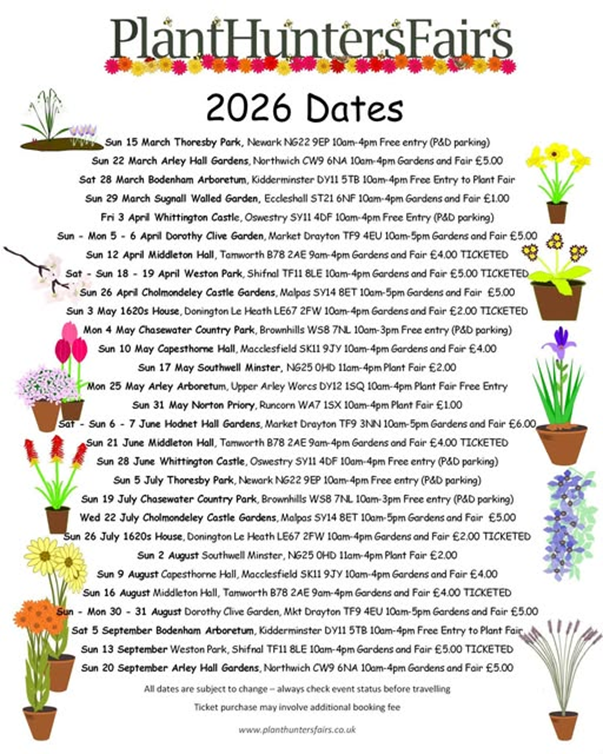
Events coming up in our local area and beyond:
NEWSLETTER – December 2025
From our Chair and the Committee
Our talks coming up:


November’s talk – Hellebores
What a brilliant talk, given by Samantha Hopes, telling us all about hellebores covering every aspect. There is no excuse now not to have a fantastic display in the Spring in our gardens. Her knowledge on the species is incredible, and you could tell that these plants are very special to her. Samantha brought some beautiful plants for us to buy and her own made cards. We will definitely be inviting Samantha back in the future to share more of her knowledge about plants.
She also reminded the meeting that Ashwoods, in the Spring, have special hellebore tours so please do check on Ashwoods website to find out more details and the dates when these tours will take place. Combined Garden and Hellebore Tours – Ashwood Nurseries
If you missed Gardener’s World on Friday 5th December, do find it on the BBC iplayer as Ashwoods and Samantha’s husband, Nigel, were featured. What a beautiful piece so please do find it and enjoy.
Thank you to Rosie from Craft Creations for bringing such wonderful items from the shop for us to purchase. All the items having been made by local residents.
Thank you also to Karen and Jo for making sure that we all had tea and coffee when we arrived. Thank you to Ruth for organising the tea rota. Do sign up to help and you can find the tea rota on the desk as you arrive in the Hall.
December talk – Bee Curious
As our Year of the Bee comes to an end, we will enjoy a talk by Clun resident, Steve Knight, a professional forester, ecologist and beekeeper, for a fascinating look into the world of bees and the plants that sustain them. Discover how different bee species live and work, which garden plants provide the best nectar and pollen, and how the hive produces honey, wax, and other remarkable gifts. A perfect pre-Christmas evening — with local honey and candles available to purchase.
We will also have our usual Christmas special raffle, mulled wine and nibbles. We won’t be serving tea and coffee at this meeting.
Flower of the Month in November and December
Dorothy with her beautiful Kaffir Lily. Thank you to Helen who has taken over running the Flower of the Month from Mellie.

A reminder there will be no Flower of the Month at the December meeting but instead please bring a small table arrangement on the theme of the Robin Redbreast for which there will be a prize on the night.
Wreath and table decoration workshop
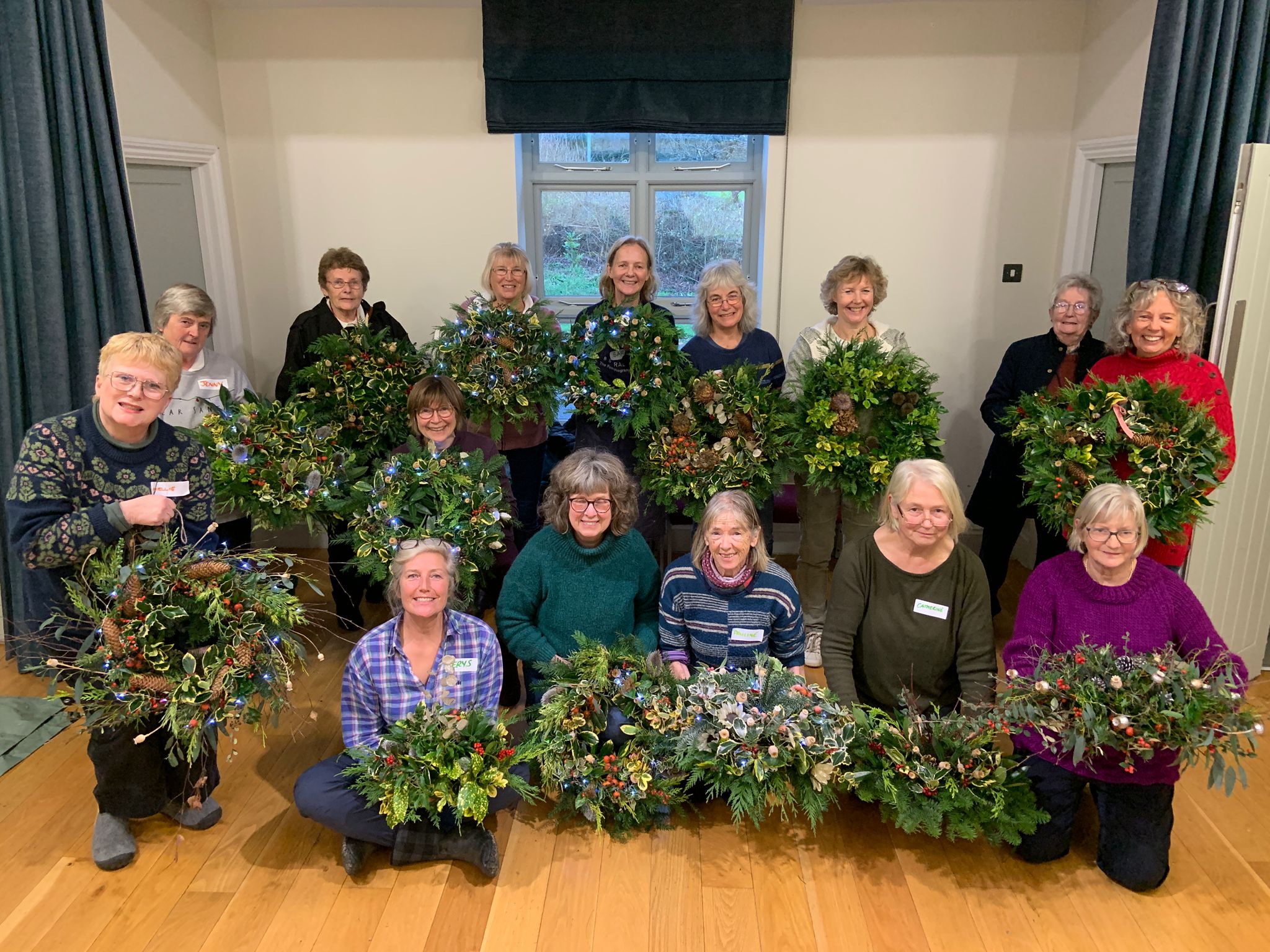
A group of 15 gardening club members and friends enjoyed a festive afternoon making Christmas wreaths and table decorations at Lydbury North Village Hall under the expert guidance of retired florist, Claire Labrum, and artist, Alison Schofield. Music and delicious refreshments added to the amazing abundance of foliage, seedheads and ornaments provided, to make this an event to be repeated! Thank you to our Committee members, Elly and Cerys who worked so hard to make the afternoon run smoothy. The choice of foliage and decorations including lights to include, was amazing.
January meeting – EGM at the start
At this meeting, at the start, there will be a brief Extraordinary General Meeting called to vote on three items. Our new Data Protection Policy, an updated Constitution and to vote in the Vice Chair and the Secretary which did not happen at the AGM back in October. More information below. Please also take a few minutes to look at the Draft Data Protection Policy and Procedures and the updated Constitution on our website. Links below.
Data Protection Policy
As a Club, we collect personal information about our members, and we have a duty to protect your privacy. We are aware that we should not be collecting or storing any information about you unless it is for a legitimate purpose (e.g. to inform you of meetings, trips, events etc.) We have recently looked at what is collected and why, and how it is stored or deleted, and have drawn up a draft Data Protection Policy and Procedures for the Club to follow.
We intend to keep members’ details on record for up to one year after membership expires, in case people wish to rejoin, but will delete records of any lapsed members beyond that time period.
We would like to continue to send an email reminder each month to notify you that the latest Newsletter is live on the website. This email only goes to people who have agreed for their email addresses to be used in this way, and recipients can unsubscribe at any time. Lapsed members will be deleted from that mailing list 12 months after their memberships expires.
If, on the other hand, you have not been receiving the Newsletter notification, but would like to, please contact our Membership Secretary, Sara by email and you can be added to the mailing list. spsararoberts@btopenworld.com
Please take a few minutes to look at the Draft Data Protection Policy and Procedures on our website. We will have an opportunity to discuss this at our Extraordinary General Meeting (EGM) session within the Club meeting in January. draft-data-protection-policy.pdf
Draft Constitution update
At the EGM in January, we will also look at the proposed Draft Constitution as the old Constitution is now outdated and with the lack of Committee members, we no longer complied. The proposed Constitution means that we can still run with fewer committee members. This can be viewed on our website Club Policies – South West Shropshire Gardening Club
On the subject of Committee members, we would love to welcome some more people to join the Committee. We meet about four times a year and enjoy tea, coffee and cake! It would be great to have some more help as we are down four members.
Plant of the Month – The poinsettia plant
From the family of Euphorbiaceae, indigenous to Mexico and Central America, how did this rather un-British plant become a symbol of our Yuletide celebration? In Mexico, the plant is a symbol of folklore with the association beginning with a Mexican child named Pepita who was poor, with no gift to take to church, so she picked some wildflowers and weeds as an offering for Christmas Eve gathering at Church. The bouquet she so carefully selected did miraculously turn into the beautiful blooms of the poinsettia, and was then presented at the altar, thereafter, being known as ‘Flowers of the Holy Night’ meaning ‘any gift of love is a beautiful gift’. The star-shaped bright red leaves, which are not flowers but bracts or modified leaves, are seen as a symbol of the star of Bethlehem. The bright red leaves are a symbol of the blood of Christ. The white leaves, when present, symbolise the purity of Christ. The Franciscan friars in the17th Century, gathered the plant to decorate churches and nativity scenes during Christmastide.
International introductions are credited to Joel R Poinsett, to whom the plant is named after, although previously, it was called the ‘Mexican Flame Flower ‘. During 1820s, Mr Poinsett was an Ambassador for the United States in Mexico where he became interested in the plant and saw an opportunity to market it in America. Much work was done by the Ecke horticulturalist family who heavily promoted the plant in the US during the 20th Century leading to the Congress declaring 12th December as ‘National Poinsettia Day’. It is believed that the family produces 70% of the market in the US. The poinsettia was described as a new species by the German scientist Johann F Klotzsch in 1834. It was introduced to the UK by James McNab, a curator for the Royal Botanical Garden in Edinburgh in 1834 and was much admired with the story captivating the hearts of the British public.
Euphorbia Pulcherrima
The small house plant that appears in our shops during the festive period is not really a true representation of the plant as really it is a small tree or large shrub with a growing height of up to 4 metres, like on the island of El Hierro, (see the photograph taken by Mellie in November 2024). The tree is easily 3 metres high. The flowers are rather inconspicuous small yellow structures that are found in the centre of the red bracts.

Excess Plants/Plant Swap
We will be having a table at the back of the hall at our meetings for you to bring any surplus plants so that others can have them. The only thing we ask is if your plants have not been taken by the end of the talk, please take them away with you.
Seed Order
The D T Brown seed order has been sent and that orders exceeded the threshold necessary to qualify for 50% discount which is excellent news. The seeds will be delivered to Elly in January hopefully in time for the January meeting which is late in the month but if not, they will be available at the February meeting.
Wormery
We still have one small wormery that needs a new home for a small donation. This wormery was given to us by someone living in Craven Arms who had no use for it anymore. Please contact Mandy bonnilass@hotmali.com if you would like to find out more about it.
Members’ much-loved plants
Abutilon Red Tiger (Family: Malvaceae) (Atn Rt5) is a semi-evergreen
shrub which grows to around 2m with upright, slightly arching branches and soft maple-like leaves. Nodding, bell-shaped flowers are yellow but heavily veined in red and produced from Spring to Autumn. The RHS recommended places to grow this plant are city and courtyard gardens, flower borders and against walls. Mandy, our Vice-Chair, tells us how she came to have this exotic plant: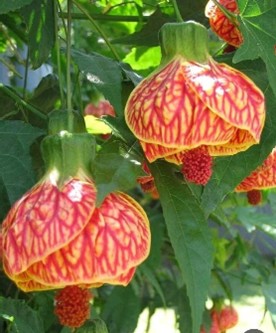
“I bought this Abutilon at the Hergest Croft Autumn Plant event. It was love at first sight and I knew I was not going home without it. £10 well spent. And thankfully it is still thriving three years later. However, it doesn’t start to flower until end of September with me when I bring it into the house (not central-heated). It seems to love being in my hallway and everyone comments on what a lovely flower it has and how exotic. I think next year I will try and find the sunniest part of my garden to see if I can get some flowers earlier in the year.”
RHS Affiliation
Don’t forget that our club is affiliated to the RHS so I can lend you a discount card which offers 50% off entry for two people, to any RHS Garden (Bridgewater, Harlow Carr, Hyde Hall, Rosemoor and Wisley). It is not accepted for visits during Flower Shows and Glow Illumination events.
Membership
DUE ! Membership costs £20 to cover attendance at all our meetings for a year (from October); early access to trips and events with subsidised tickets; seed offers and plant sales. We are affiliated to the RHS so you can borrow our discount card which provides 50% discount for two people to any RHS garden. Such a bargain! Payment can be made with cash, cheque or card at our meetings or by transfer to: South West Shropshire Gardening Club sort code 20-53-22 account number 80754803. Please add your name as reference and email our Treasurer, Tina, to let her know: swsgcbookings@gmail.com
Plant Heritage
We also belong to Plant Heritage and have two cards which enable members to attend local meetings and events. Please contact Mellie if you would like to use the cards.
The Club’s Social Media
Don’t forget that we have an active website and Facebook page, which are regularly updated. You can post on the FB page, and this will be loaded up once it has been approved by the Administrator. It is a great way of sharing news about all things gardening.
A bit of health and safety
As we are now well into the season for coughs and sneezes, please, if you feel unwell, reconsider whether you should be coming to an indoor event. Covid still is around as is flu and we do have several vulnerable people who do attend the meetings.
Talks booked for 2026
28th Jan
Adam Kirtland – Garden DIY Using Just a Wooden Pallet
25th Feb
Gavin Stoneystreet – The Gardens of William Morris 25th March Pete Carty – Minsterley Meadows
22nd April
Philip Aubery – Propagation – New plants from seeds, cuttings and division
27th May
Matt Wright – Bonsai
June
No talk – Garden trip this month
22nd July
Sam Shepherd – Self-sufficiency in 2026 – The good life – Part 1
August
No talk this month
23rd Sept
Paul Green – Grasses
28th Oct
Rozanne Delamore – The Ledbury Flower Farmer, growing seasonal sustainable cut flowers
25th Nov
Jill Cawthray – Not all Nettles – Wildlife Gardening without the Wilderness
6th Dec
Sam Shepherd – Storing and preserving your fruit and vegetables – Part 2
The Committee would like to wish all our members a very Happy Christmas and a Peaceful New Year and we hope to see you at the December meeting
November 2025
From our Chair and the Committee
We remember David Pittwood
We have learnt of the sad passing of one of our long-standing members, David Pittwood. We are hugely sorry to hear this news and will miss David who regularly attended our Club talks and came on our outings with his wife Pam over many years. As many of you know, Pam and David hold regular plant stalls in Clun outside the Methodist Church to raise funds for local and humanitarian charities and we all look forward to the Saturday sales throughout the season. David will be very much missed by us all. We send our love to Pam and we are here to help in any way we can throughout this sad period of time for her.
Our talks coming up:
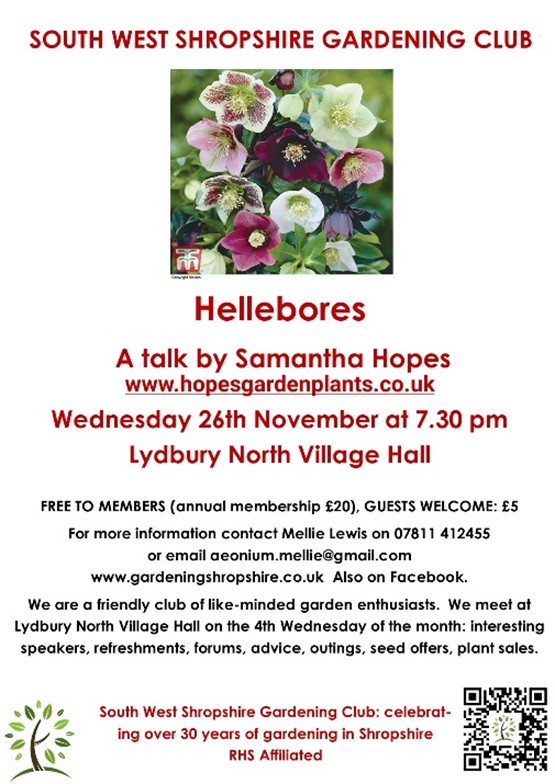
November talk
We will be joined by Samantha Hopes who has been to talk to us before. This time she will be talking to us about Hellebores which, as we all know, are so important for the pollinators out early in the year. Samantha has a wealth of experience working at various gardens.
After graduating, Samantha went to work alongside John Massey looking after his Hepatica collection. This became one of her passions, alongside specialist alpines and a new breeding program with Roscoeas. Samantha, with her husband Nigel, has thrown herself into creating and building their own garden, propagating and growing unusual plants to sell at talks, as well as looking after their family.
Also at the November meeting, we are thrilled that Craft Creations from Clun will be bringing a selection of their handmade items, specifically with a Christmas theme so don’t forget to bring some extra money to purchase all those Christmas presents. It is great to be supporting local crafts people.
Looking back at our October talk
What a thought-provoking talk given last month to the Club by Jack Willgoss from Wildegoose Nursery in the Corvedale! There was so much to take in and to consider how we should be gardening in this now unpredictable climate. It is all quite frightening.
There were many take-homes from the evening, and here are some, hopefully most of us are doing some of these already:
- Avoid chemicals
- No dig – why put the topsoil under the subsoil!
- Do not cut back until late winter and use the stems to mulch
- Use peat-free compost – (Ransfords in Bishops Castle do stock Melcourt which is a compost that Jack recommends. Please ring them to check they have this in stock.)
- Avoid watering unless there is no rain for two weeks after fresh planting
- Wherever possible, buy organic bulbs – less is more as the saying goes
- Buy small plants for better results rather than larger specimens
- Save your own seed wherever possible rather than buying in seed
Jack gave out to us a lists of plants that he would recommend people to consider planting and you can find this on our resource page (www.gardeningshropshire.co.uk). Their nursery will open again in the Spring so do please check their website for their opening date www.wildegoosenursery.co.uk
AGM last month
Farewell and thank you to Angie Salmon – Prior to Jack’s talk, there was a short AGM and we were sad to say farewell to Angie Salmon who has guided us in her role as Chair over the last three years. In total, Angie has given twelve years to the Club and so she feels it is time for her to take her place in the audience now. Thank you, Angie for all your years. We hope that you enjoy the tree that you will buy as the Club’s gift to you.
The New Committee – Mellie Lewis, known to many of you as Aeonium Mellie!, has now stepped up to the role of Chair, with Mandy Ford taking on the role of Vice-Chair and who will continue to assist with booking speakers. Tina McAra will be taking on the Treasurer’s role, looking after the website and booking the speakers, Sara Roberts will be taking over as Membership Secretary and Elly Bibby will continue in her role as Secretary which she has done brilliantly, Pauline Owens will continue with the raffle. Sadly, we lost Caroline Hughes, Alleyne Copestake and David O’Neil from the Committee. Thank you for your help during your participation.
We were delighted that Helen Brown has offered to help run the Flower of the Month competition and Ruth Webb has offered to run the Tea Rota and make sure that teas and coffees are served on the night. And that Caroline Hughes will continue to help us whenever she can on the night. Thank you all.
Please do consider offering to help – you don’t need to be on the Committee – Just let one of the Committee members know if you would like to know more about the help we need either on the night or during the year.
Flower of the Month in October and the Annual Prize for most points
Well done to Pauline Edie with her winning Café Au Lait dahlia that won the October competition, starting off our new year with a zing.
Also, congratulations to Dorothy Morris who took the overall 1st prize for the Flower of the Month Year, with Rosemary Morris 2nd and Sara Roberts 3rd. You have got to be in it to win! Remember, bring a single bloom or spray from your garden to participate. Points are given each month and then the overall winner will be announced at our AGM in October. Please note that, to be fair, we can only accept one entry from each participant.
Year of the Bee
As our Year of the Bee is almost over, here are some interesting names that bumblebees are, and have been, called over the years:
It wasn’t until the 1950s that the name bumblebee stuck. They are also known as:
Dumbledore (18th century) – yes, the inspiration for J.K. Rowling’s wizard!
Humblebee (Until 1910)
Drumbledrone (Devon)
Foggy Bummer (NE Scotland)
Cacynen (Welsh)
Bumbóg (Irish)
Seillan (Gaelic)
What name do you like to call them by?
Plant of the Month
We thought it would be fun to talk about a Plant of the Month. Here is our first one for our new Membership year which runs from October to September. This has been submitted by Mellie. If you would like to tell us about a special plant, email aeonium.mellie@gmail.com
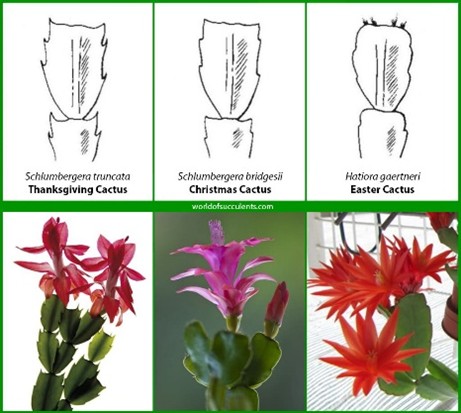
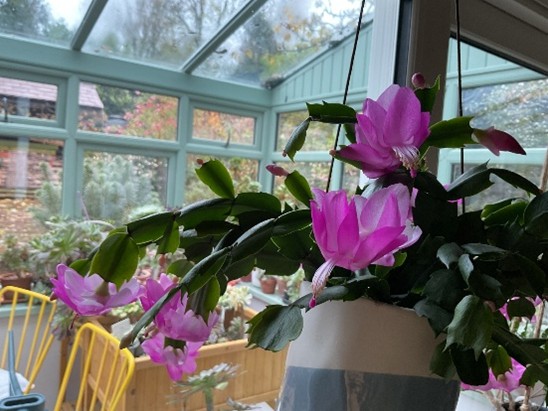
Thanksgiving cactus, botanical name Schlumbergera truncata. This is a tropical, epiphytic cactus that blooms during the autumn. Below is one of mine in shades of pink! There are two other similar plants in the genus, Christmas flowering and Easter flowering, see diagram below showing the differences. At a time of the year when little else is flowering their cheerful blooms always make me smile, and if you have one of each variety then you can rest assured you will have beautiful blooming houseplants all through the dark cold seasons. To care for it, provide bright, indirect light, water when the top of the soil is dry, and ensure well-draining soil. It also appreciates cooler temperatures.
Excess Plants/Plant Swap
After the success of Ed and Mary’s day lilies that we were able to have as they had too many, at each meeting from now on, we will have a table for members to bring in any excess plants that they would like to pass on. The only condition is that if they are still left at the end of the meeting you need to take them home with you. A great idea as plants are so expensive to buy now – the prices have rocketed!
Members’ plants
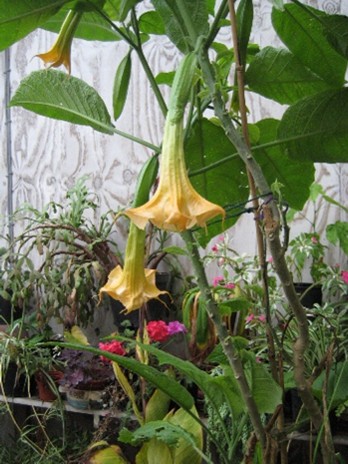
Anne Shepherdson, one of the Founding Members of the Gardening Club, bought this Trumpet Brugmansia just before start of Covid from a jumble sale, very cheaply. Since then, it sulked but Anne’s message is never give up because this year (maybe due to the warm weather) it has excelled as you can see. Anne’s message is never give up hope.
Seed Order
The D T Brown seed order catalogues are available. The discounts offered to Club members this year include 50% on seed, 20% off grow your own products and 10% off Darlac tools and birdseed. Order forms need to be returned at the next meeting in November so if you want a catalogue or cannot return your order form at the November meeting (and can’t find a friend to do it for you!) then please contact Elly Bibby on 0780 2497780. As usual, no payment is required up front and is due once you have received the seeds in January.
Christmas Workshop – 27th November – 2 pm – 4.30 pm
Lydbury North Village Hall
A few places left so don’t delay. Led by Alison Schofield, a retired art teacher and silversmith, and Claire Labrum, retired florist. All materials including a generous quality of foliage, seed heads and Christmas style decorations will be provided but you are welcome to bring any of your own favourites. Please choose between wreath making or a table decoration when booking. To reserve your place, please contact Elly Bibby 07802497780 or ellisonbibby05gmail.com
RHS Affiliation
Don’t forget that our club is affiliated to the RHS so I can lend you a discount card which offers 50% off entry for two people, to any RHS Garden (Bridgewater, Harlow Carr, Hyde Hall, Rosemoor and Wisley). It is not accepted for visits during Flower Shows and Glow Illumination events.
Membership
DUE LAST MONTH! Membership costs £20 to cover attendance at all our meetings for a year (from October); early access to trips and events with subsidised tickets; seed offers and plant sales. We are affiliated to the RHS so you can borrow our discount card which provides 50% discount for two people to any RHS garden. Such a bargain!
Payment can be made with cash, cheque or card at our meetings or by bank transfer to: South West Shropshire Gardening Club sort code 20-53-22 account number 80754803. Please add your name as reference and email our Treasurer Tina McAra to let her know: swsgcbookings@gmail.com
Plant Heritage
We also belong to Plant Heritage and have two cards which enable members to attend local meetings and events.
Social media
Love it or loath it, remember that we have a packed website (www.gardeningshropshire.co.uk) and a Facebook page, both of which are great ways of sharing information. Please do visit them both as we regularly post updates and information about events in our local area. If you have anything that you would like to share, please email bonnilass@hotmail.com or on Facebook you can post directly and this will be posted once approved by the Administrator.
A bit of health and safety
As we are now well into the season for coughs and sneezes, please, if you feel unwell, reconsider whether you should be coming to an indoor event. Covid still is around, as is flu, and we do have several vulnerable people who do attend the meetings.

See you all on Wednesday 26th November for the Hellebore talk
 South West Shropshire Gardening Club